
CATCH
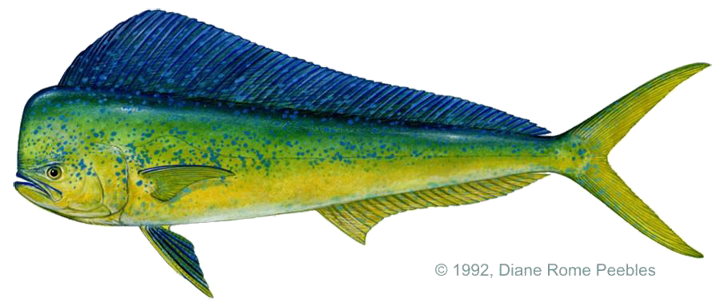
Dolphinfish, Dolphin, mahi mahi, dorado, goldmakrele, shiira.
Current All Tackle Record: 87 lbs. 0 ounces
Found worldwide in tropical and warm temperate seas, the dolphinfish is pelagic, schooling, and migratory. Though occasionally caught from an ocean pier, it is basically a deep-water species, inhabiting the surface of the open ocean. The dolphinfish is a distinctive fish, both for its shape and its colors. Though it is among the most colorful fish in the sea, the colors are quite variable and defy an accurate, simple description.
Large males have high, vertical foreheads, while the female’s forehead is rounded. Males grow larger than females.
They are extremely fast swimmers and feed extensively on flying fish and squid as well as on other small fish. They have a particular affinity for swimming beneath buoys, seaweed, logs, and floating objects of almost any kind.
Hooked dolphin may leap or tailwalk, darting first in one direction, then another. It is believed that they can reach speeds up to 50 mph (80.5 kph) in short bursts. Successful fishing methods include trolling surface baits (flying fish, mullet, balao, squid, strip baits) or artificial lures; also live bait fishing or casting. If the first dolphin caught is kept in the water, it will usually hold the school, and often others will come near enough to be caught by casting.
In addition to being a highly rated game fish, the dolphin is a delicious food fish. It is referred to as the “dolphinfish” to distinguish it from the dolphin of the porpoise family, which is a mammal and in no way related.
MORE.. https://www.igfa.org/species/69-dolphinfish.aspx?CommonName=69-dolphinfish.aspx
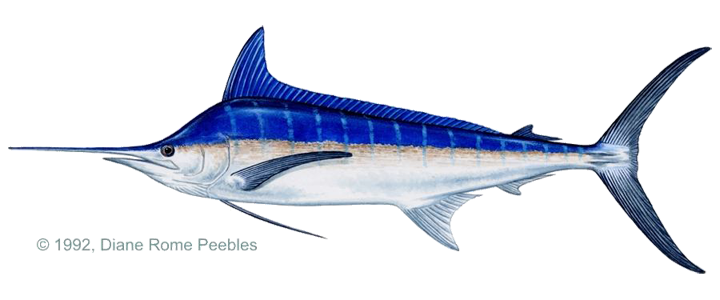
Current All Tackle Record: 1402 lbs. 2 ounces.
This pelagic and migratory species occurs in tropical and warm temperate oceanic waters. In the Atlantic Ocean it is found from 45°N to 35°S, and in the Pacific Ocean from 48°N to 48°S. It is less abundant in the eastern portions of both oceans. In the Indian Ocean it occurs around Ceylon, Mauritius, and off the east coast of Africa. In the northern Gulf of Mexico its movements seem to be associated with the so called Loop Current, an extension of the Caribbean Current. Seasonal concentrations occur in the southwest Atlantic (5°-30°S) from January to April; in the northwest Atlantic (10°-35°N) from June to October; in the western and central North Pacific (2°-24°N) from May to October; in the equatorial Pacific (10°N-10°S) in April and November; and in the Indian Ocean (0°-13°S) from April to October.
Japanese longliners report that the blue marlin is the largest of the istiophorid fishes. It apparently grows larger in the Pacific. All giant marlins are females, and male blue marlin rarely exceed 300 lb (136 kg). The pectoral fins of blue marlin are never completely rigid, even after death, and can be folded completely flat against the sides except in the largest specimens. The dorsal fin is high and pointed anteriorly (rather than rounded) and its greatest height is less than the greatest body depth. The anal fin is relatively large and it too is pointed. Juveniles may not share all the characteristics listed above, but the peculiar lateral line system is usually visible in small specimens. In adults it is rarely visible unless the scales or skin are removed. The vent is just in front of the anal fin, as it is in all billfish except the spearfish. The back is cobalt blue and the flanks and belly are silvery white. There may be light blue or lavender vertical stripes on the sides, but these usually fade away soon after death, and they are never as obvious as those of the striped marlin. There are no spots on the fins.
They are known to feed on squid and pelagic fishes, including blackfin tuna and frigate mackerel. A powerful, aggressive fighter, they run hard and long, sound deep, and leap high into the air in a seemingly inexhaustible display of strength. Fishing methods include trolling large whole baits such as bonito, dolphin, mullet, mackerel, bonefish, ballyhoo, flying fish and squid as well as various types of artificial lures and sometimes strip baits.
Some taxonomists believe that the Atlantic and Pacific blue marlins are closely related but separate species. They apply the scientific name Makaira nigricans, Lacepede, 1892, to the Atlantic species only and the name Makaira mazara (Jordan & Snyder, 1901) to the Pacific and Indian Ocean species. Others treat the two populations as subspecies, Makaira nigricans nigricans and Makaira nigricans mazar
https://www.igfa.org/species/66-marlin-blue-atlantic.aspx?CommonName=66-marlin-blue-atlantic.aspx
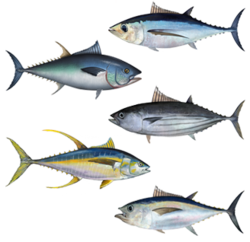
The tuna is a saltwater finfish that belongs to the tribe Thunnini, a sub-grouping of the mackerel family (Scombridae) – which together with the tunas, also includes the bonitos, mackerels, and Spanish mackerels. Thunnini comprises fifteen species across five genera,[1] the sizes of which vary greatly, ranging from the bullet tuna (max. length: 50 cm (1.6 ft), weight: 1.8 kg (4 lb)) up to the Atlantic bluefin tuna (max. length: 4.6 m (15 ft), weight: 684 kg (1,508 lb)). The bluefin averages 2 m (6.6 ft), and is believed to live for up to 50 years.